Free to read No advertising

The Daily Noggin

Thursday, October 29, 2026
Text size

Health & Wellbeing

A Glass of Water, Twice as Important

Why staying well watered matters more with every birthday, and simple ways to make it a habit.
Drawing of a pitcher and a glass of water with a slice of lemon

Of all the good habits a person can keep, drinking enough water may be the simplest. It costs next to nothing, needs no equipment and can be done in an armchair. Yet it is one of the habits most easily forgotten, especially as the years go by.

The reason is a quiet change in the body. Our sense of thirst tends to grow weaker with age, so the gentle signal that once said "time for a drink" may arrive late, or not at all. At the same time, the kidneys become a little less efficient at holding on to water, and some common medicines, such as certain blood pressure pills, can make the body lose fluid more quickly.

Water does a great deal of work behind the scenes. It helps carry nutrients around the body, keeps joints cushioned, helps regulate temperature and keeps digestion moving. When we run low, the first signs are often easy to mistake for something else: tiredness, a headache, feeling light-headed on standing, dry lips or a little confusion.

How much is enough? It varies from person to person. As a general guide, the U.S. National Academies have suggested a total daily water intake of about 2.7 liters (roughly 11 cups) for women and 3.7 liters (roughly 16 cups) for men, but that figure counts water from every source, including food. Soups, fruit, vegetables, milk, tea and coffee all contribute. Many people find it simplest to aim for a drink with every meal and another between meals.

A few small tricks can help the habit stick. Keep a glass or a favorite cup where you can see it. Take a drink each time you take your pills. Add a slice of lemon, cucumber or a sprig of mint if plain water feels dull. Fruits such as melon, oranges and grapes are mostly water and count toward the day's total. In hot weather, or after gardening or a long walk, have a little extra.

A useful check is the color of your urine: pale straw-colored usually means you are drinking enough, while dark yellow suggests you could do with more.

One word of caution. People with certain heart or kidney conditions are sometimes advised to limit how much they drink. If that applies to you, your doctor's advice comes first.

For most of us, though, the message is a cheerful one. A good, long drink of water is one of the kindest things we can do for ourselves, and it is never too late to make it part of the day.
Written for The Daily Noggin.

Living Well

The Pleasure of a Handwritten Letter

In an age of instant messages, a letter in the mail is a small gift worth giving.

Drawing of a stamped envelope and a fountain pen

There is a particular pleasure in finding a handwritten envelope among the bills and circulars. Before it is even opened, a letter tells you that someone sat down, thought about you and took the time to write.

Sending a letter was not always easy or cheap. Before 1840, postage in Britain was charged by distance and by the number of sheets, and it was usually paid by the person receiving the letter. Rowland Hill, a schoolmaster and reformer, argued that a single low price, paid in advance by the sender, would make mail affordable for everyone. His Uniform Penny Post began in January 1840, and that May the world's first adhesive postage stamp, the Penny Black, came into use. Letter writing grew enormously, and other countries soon followed with stamps of their own.

For generations afterward, letters were how families kept in touch across oceans, how sweethearts courted and how news of births, weddings and harvests traveled. Many people still treasure a bundle of old letters tied with ribbon, the handwriting itself as familiar as a voice.

Writing a letter today needs no special skill. A few simple ideas can make it easier to begin:

Start small. A postcard or a short note is perfectly fine. Three or four sentences about your week, a question about theirs and a warm sign-off make a lovely letter.

Write as you speak. A letter does not need to be formal. Tell a little story, describe what you can see from your window, mention a book you enjoyed or a meal you cooked.

Ask a question. Questions invite a reply and keep a correspondence going. What are they growing in the garden this year? What was the best vacation they ever had?

Add a little something. A pressed flower, a newspaper cutting, a recipe card or a photograph turns a letter into a small parcel of friendship.

Choose your materials. Some people love good writing paper and a fountain pen; others are happy with a lined pad and a ballpoint. What matters is the writing, not the stationery.

Letters also do the writer good. Taking a quiet half hour to gather your thoughts, remember a shared joke or count your blessings can be calming and cheering in itself.

Grandchildren, old school friends, a neighbor who has moved away: almost everyone is delighted to receive a letter, and many will write back. Somewhere, a mailbox is waiting.

Written for The Daily Noggin.

Travel & Places

All Aboard: The Pleasures of a Long Train Journey

Slow travel by rail offers wide views, good company and time to simply watch the world go by.

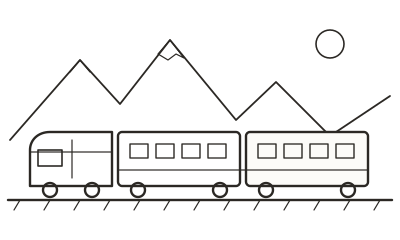
Drawing of a passenger train crossing open country below mountains

There are faster ways to cross a country, but few that are as relaxing as the train. There are no seatbelts to fasten for hours on end, no traffic to watch and plenty of room to stretch your legs. The scenery changes slowly outside a large window, and the journey becomes part of the vacation rather than something to be endured.

Long-distance rail travel has a proud history in America. On May 10, 1869, a ceremonial golden spike was driven at Promontory Summit in Utah, joining the Central Pacific and Union Pacific railroads and completing the first transcontinental railroad. A journey that had taken months by wagon could now be made in about a week.

Today, passenger trains across the United States are run by Amtrak, which began service in 1971. Several of its long-distance routes are famous for their scenery. The California Zephyr runs between Chicago and Emeryville, near San Francisco, covering about 2,400 miles in roughly two days. Along the way it climbs through the Rocky Mountains, follows the Colorado River through deep canyons and crosses the Sierra Nevada. Other routes trace the Pacific coast, the Mississippi valley and the forests of the Northwest.

Part of the charm is the life on board. Many long-distance trains have a dining car, where travelers are often seated together and conversations with strangers turn into friendships for the day. Observation cars, with windows reaching up into the roof, are a favorite place to sit with a cup of coffee and watch the landscape unfold. For overnight journeys, sleeping compartments turn into beds, and there is something very comforting about being rocked to sleep by the motion of the train.

A few tips can make a rail journey even more enjoyable:

Book a seat on the scenic side if the railroad offers that choice, and check the timetable to see which landscapes you will pass in daylight.

Pack a small bag for your seat with the things you will want close at hand: a book, a sweater, reading glasses, any medicines and a bottle of water.

Ask about assistance. Railroads can usually help with boarding, luggage and accessible seating if you let them know in advance.

Take your time. Consider breaking a long journey with a night or two in a town along the route.

Above all, a train journey is a chance to slow down. Watch the farms, rivers and small towns slide past, share a story with the person across the table and let the miles take care of themselves.

Written for The Daily Noggin.


History & Heritage

Open to All: The Story of the Public Library

How the idea of free books for everyone grew from a small club into one of America's best-loved institutions.

Drawing of a library building with columns and wide front steps

Few buildings are as welcoming as a public library. Anyone may walk in, sit down and read, and with a library card take home armfuls of books for nothing. It seems so natural today that it is easy to forget it was once a bold idea.

In 1731, a young Benjamin Franklin and a group of friends in Philadelphia founded the Library Company of Philadelphia. Books were expensive and scarce in the colonies, so the members pooled their money to buy them and share them. It was a subscription library, open to those who paid, but it showed how much more people could read together than alone. The Library Company still exists today.

Over the following century, many towns had small subscription or social libraries, and some had libraries attached to schools or churches. The great change came with the idea that a library should be paid for by the community and free to every resident. The Boston Public Library, founded in 1848 and opened to readers in 1854, was the first large free municipal library in the United States, and its success inspired cities across the country.

The biggest boost came from Andrew Carnegie, the Scottish-born steel industrialist who had arrived in America as a poor boy. As a young telegraph messenger, he had been allowed to borrow books from a private collection, and he never forgot it. In his later years he gave away much of his fortune, and from the 1880s until around 1920 his grants paid for well over two thousand library buildings around the world, more than 1,600 of them in the United States. Towns were asked to provide the land and promise to pay for books and staff, so each library became a partnership with the community.

Many of those Carnegie libraries still stand, with their grand steps and handsome reading rooms, and many are still in use.

Libraries have kept changing with the times. Children's rooms and story hours became common in the early twentieth century. Bookmobiles carried books to farms and small villages. Today's libraries also lend audiobooks and e-books, offer computers and help with forms, and host talks, clubs and classes.

Yet the heart of the idea is the same as it was in Franklin's day: knowledge and stories grow richer when they are shared. Next time you pass your local library, it may be worth stepping inside to say hello.

Written for The Daily Noggin.

Arts & Culture

Norman Rockwell and the Art of Everyday Life

For nearly half a century, his magazine covers found the extraordinary in ordinary American moments.

Drawing of an artist's easel with a painting of a small house, a palette and brushes

For millions of Americans, a new issue of The Saturday Evening Post was something to look forward to, and very often it was the cover that caught the eye. Between 1916 and 1963, Norman Rockwell painted 323 of those covers, and many readers came to feel they knew his characters as well as their own neighbors.

Rockwell was born in New York City in 1894 and knew early on that he wanted to be an illustrator. He studied art as a teenager and was still very young when he sold his first cover to the Post in 1916. It was the beginning of one of the longest partnerships in American magazine history.

His gift was for noticing small moments: a boy nervously waiting at the doctor's office, a family gathered around a holiday table, a runaway child sharing a lunch-counter stool with a kindly policeman. He painted ordinary people with warmth and gentle humor, and the details repay a second look. A crumpled letter, a dog's expression or a worn pair of shoes often tells part of the story.

Rockwell worked painstakingly. He would sketch ideas, find local people to act as models, arrange costumes and props, and in later years photograph his scenes before painting them in oils. Many of his models were friends and neighbors in the small towns where he lived, first in Arlington, Vermont, and later in Stockbridge, Massachusetts.

During World War II he painted his Four Freedoms, inspired by a speech by President Franklin D. Roosevelt. The paintings toured the country and helped raise money for the war effort through bond sales.

In the 1960s, after leaving the Post, Rockwell worked for Look magazine and turned to more serious subjects, including civil rights and the space program, showing that his eye for human feeling could rise to the great events of the age.

For many years, critics dismissed his work as mere illustration. Time has been kinder. His paintings are now shown in major museums, and the Norman Rockwell Museum in Stockbridge holds the world's largest collection of his original art. Rockwell died in 1978, but his pictures still invite us to smile, to remember and to look a little more closely at everyday life.